Showing posts with label solutions. Show all posts

Tuesday, March 22, 2011

Earth Hour--March 26, 2011! Party in the Dark! :)


My Earth Hour Lantern, 2009


This is your friendly reminder that on March 26th, which is in 4 days, this Saturday, it will be Earth Hour!!!


Watch this beautiful and inspiring video, the Official Earth Hour 2011 video. :)


What is Earth Hour:

*

Earth Hour started in 2007 in Sydney, Australia when 2.2 million individuals and more than 2,000 businesses turned their lights off for one hour to take a stand against climate change.


*

...Earth Hour 2010 became the biggest Earth Hour ever. A record 128 countries and territories joined the global display of climate action. Iconic buildings and landmarks from Asia Pacific to Europe and Africa to the Americas switched off. People across the world from all walks of life turned off their lights and came together in celebration and contemplation of the one thing we all have in common – our planet.


*

There will be those assholes (yes, assholes) who will turn on all the lights in their home, thinking they are being clever in their juvenile form of protest. To those people I have nothing to say.

There will be others (not assholes, perhaps simply cynics or inquisitive types) who will question what good an hour with no power does. To those I offer two things.

One: it highlights the power of conservation. If a relative handful of people in one hour of lights-off saves energy and reduces carbon emissions, what could we accomplish with long term, concerted, committed, cooperative solutions? For example:

*

...during the 8 pm to 9 pm duration, Chicago saved about 7 percent in energy. The 818 megawatt hours of electricity saved are equivalent to nearly 1.3 million pounds of carbon dioxide emissions or taking two 400-megawatt coal plants offline for one hour.


*

And, two: following on the heals of that, it's about spreading awareness, both to others and within ourselves, of the very real and serious issues (despite political spin) facing us as a result of our over-consumption of ...well.. everything. The goal is to spark an interest, either initial or renewed, in changing the way we live on the Earth.


We usually get out in the backyard, enjoy some food and conversation. I take a few pictures. We've stretched it to two hours before. It can be a bit depressing, looking around and seeing that we are the only ones participating. To combat that, the kids and I give a shout to the neighborhood, "Happy Earth Hour! Whooohoooooo!"

If the thought of being an eco-nut all alone in the dark gets you down, try finding an Earth Hour event in your area, or start one of your own! I know in the past I've seen events listed on the Earth Hour site itself, but am not seeing that this year. Maybe I'm just not awake enough yet! But, a simple Google search should result in some events for this year's Earth Hour. Give it a go!

Have fun, and lights out!! :)

*

Earth Hour 2011 will take place on Saturday 26 March at 8.30PM (local time). This Earth Hour we want you to go beyond the hour, so after the lights go back on think about what else you can do to make a difference. Together our actions add up.


*


Monday, March 21, 2011

Mark Bittman on what's wrong with what we eat | Video on TED.com


Mark Bittman on what's wrong with what we eat | Video on TED.com


A note on local eating: yes, in the past there was no label on the type of eating one did. Today, however, with our food culture being so out of whack, should one decide that they want to eat locally, it takes a concerted effort. That concerted effort naturally inspires labels. Eating locally is not "elitist" if it's done for health of community and self. A carrot that came from across town, that was picked yesterday and eaten today is much healthier for us. And, a local farm is healthy for the community and the Earth. It isn't elitist to want to know where your food comes, and for the farmers and ranchers to be visible and answerable to their customers.

Mark Bittman writes my favorite cookbooks: How to Cook Everything and How to Cook Everything Vegetarian.

Saturday, March 19, 2011

What Fits the Land


This farmer, on the brink of financial ruin, learned a lesson from his cows and the way they grazed when allowed to graze freely. He no longer spends money on chemicals and fertilizers, and milk production is up. Ever hear that happier cows make more milk? That first morning after they broke out and grazed in the field of wild oats and clover, the farmer noticed they smelled fresher, like the green pasture. They also made 200 pounds more milk than usual that morning.

These cows made me smile :) Nature knows what to do. If we are willing to watch, listen and learn rather than fight and conquer it, we all benefit.


Monday, March 7, 2011

Just Out of My Tap. That's All I Know


Thanks to the Nature Conservancy for this video


These Jaywalking-esque questioning of people off the street are always a mix of fun and fright, aren't they?

This is frightening on many levels, not only for itself but because of the many other things just like it (where does your food come from, for example). Water is essential to life. Think about someone at this mysterious source shutting off our supply. It shouldn't be something that we know nothing about, should it?

Visit sites like this one to learn where your water comes from. Watch videos like this to understand how much we've had to wrestle with Mother Nature to get what water we have, especially in the west (also comes in book format, an excellent read), and to understand our tenuous hold on this life-sustaining substance.

The kind of sleep we're in is no longer refreshing; it's making us sluggish and groggy. We need to wake up.


Sunday, February 20, 2011

Waving the Yellow Flag

I know. Nascar, like religion, is sacrosanct. It's untouchable.

You might know, or can imagine how I feel about stuff that is considered untouchable: the more something is viewed as untouchable, the more it needs to be poked and probed and disturbed. Nothing is sacred.

Let's look at some Nascar facts, some connections between Nascar and the environment, some positives, and some solutions... and a kitten.

Some numbers and things to consider :

  • the average Nascar vehicle gets approximately 5 miles per gallon of gas.
  • while our vehicles are regulated by the EPA (Environmental Protection Agency), Nascar's are not. Nascar's regulatory agency is itself.
  • In a single race weekend, 6,000 gallons of fuel are burned.
  • In that same race weekend, approximately 120,000 pounds of CO2 is released into the atmosphere
  • Nascar's yearly CO2 emissions from the races alone racks up to a whopping 4 million pounds
  • The average American, in both car and home, emits approximately 45,000 pounds of CO2 in a year.

Nascar is trying to green their image. They are promoting green vehicles at their races (not for the races, mind you) often through their efforts to promote the benefits of ethanol, they plant trees to suck up some of the CO2, they recycle their tires, and they buy carbon credits.

My opinion of carbon credits is rather low. Here's how I see it: we're all sitting around a large bowl of M&Ms. Everyone pays the same amount into the pot, and the M&Ms are divided evenly. But I want more than my fair share of M&Ms, so I buy M&M credits, allowing me to take more out of the bowl. Anyone else around the bowl with enough money can do the same. You poor bastards just keep staring into that empty bowl. Some people (Republican politicians) might argue that the problem isn't the M&M credits but the size of the bowl. In order to make it fair, they say, we need to make the bowl limitless.

Only we're not really talking candy. We're talking CO2... that which is emitted by the forces that drive our modern world, that define our current definitions of progress and wealth and freedom, and that are changing our world in ways we are not sufficiently prepared to deal with.

Other seemingly green solutions have unfortunate consequences. Ethanol, for example, which is grown from corn, has created a shortage of corn for food consumption. Plus, due to the need for more and larger corn fields here in the US, soy farms have moved into Brazil, leading to further deforestation of the Amazon rain forests. (Soy isn't just in tofu. It's everywhere... soy lecithin, textured vegetable protein, "natural" flavors, hydrolyzed vegetable protein, etc. It's another reason, in case you needed one, for ditching processed food.)


And though they say they plant enough trees to 100% mitigate the CO2, it must first use a resource that is in ever-shortening supply. This resource, rather than being burned in races or converted to rubber for tires, could be used to manufacture those things we need for a future without it (solar panels and desalination equipment, as just one example).

Recycling really should be thought of as a last ditch effort, for Nascar and all of us. We should be aiming at reducing more. Those tires, while being re-purposed and recycled, first had to be manufactured, pulling precious resources from the ground, pumping pollution in to the environment. While Goodyear is doing a good service by recycling those Nascar tires, they are a major offender in environmental pollutants. (If you follow the Goodyear link, notice how part of their efforts to clean up their act involve corn...)

It might be a stretch of the imagination at first to consider that a Nascar race, and even their green efforts, affect thins like food supplies and rainforests. But, that's the way this whole thing works. And that's why we get ourselves into such big messes. The big picture is just as important as the details, and we desperately need to look at both.

Solution: I would encourage fans of Nascar to in turn encourage Nascar to green their sport even more. Perhaps they could shorten their races a few dozen laps? Perhaps they could hold less races in a year? Perhaps they could lower their speeds just a bit? Perhaps they could drive slightly less powerful cars? As my son suggests, what about electric cars?


I know, I know... Nascar fans are clutching their chests now. I'm not a fan, so I don't connect. I can't offer some of the practical solutions to Nascar that would help the environment
and keep true to the sport. Nascar fans, it's up to you!

Saturday, February 12, 2011

Green is Patriotic

Carbon Nation the movie premiered this past Thursday the 10th of February.

I love the concept for this movie. People who one might not expect to be on board with the whole global warming thing, or people who accept it's happening but don't necessarily believe it's man made, can still be passionate about cleaning up our water and air and finding alternative energy solutions.


As a 20-year military spouse, I love that "the colonel" is represented here. In recent months I've read a few articles about the DOD's awareness of both global warming and peak oil as national security threats. The military, often seen as a conservative organization, is totally aware of the reality of what most see as tree-huggin' and/or tinfoil hat wearing causes. I wish they would be more vocal about these issues, especially for the typical military-loving neo-con FOX News viewer who is otherwise told that global warming is a liberal agenda and there is no oil shortage, just a bunch of filthy hippies keeping us from our right to Drill Baby Drill.

Take note that both the links above were the very first Google hits and lead to foreign media outlets (The UK's Guardian). For some reason, the media in the U.S. doesn't want us to know the truth. Truth, like unity, is power.

The movie looks very inspiring, and is now showing! Check your local theaters, especially the independent ones, to catch this one on the big screen.


Solar powered kitteh!

Tuesday, February 1, 2011

Coconut Oil is Really... um... greasy!


Had a slight misshap with my hair yesterday. Decided to give it a coconut oil deep condition. Put the cocunut on my ends which, having layers, is at about my ears down. Left it on for an hour. Used the baking soda water on the hair, even the ends. Twice!

No good. My hair is an oil slick.

So today I will cave, but only slightly, by using Castille soap. Here's hoping the Castille soap is strong enough to do the job. If it does, I intend to do a coconut oil treatment once a month. Will use the Castille only on the ends, avoiding the scalp to ensure I don't muck with this awesome relationship my scalp and the baking soda has going on lately. Two weeks since I stopped using shampoo and it's looking great!

Thursday, January 27, 2011

Dirty Dishes: Killing One Bird With Two Stones...

...wait, that's not very eco-friendly. Ummm... feeding two birds with one seed! That's better :)

They say washing dishes in the dishwasher, especially an energy efficient model, saves water. I beg to differ. It's all in the way it's done, and especially what's done with the water afterward.

Most dishwashers use approximately 12 gallons of water and most energy saver dishwashers use approximately 4. Water estimates for handwashing dishes are much higher, often in the 15 to 25 gallon range. I'm guessing this estimate comes mainly from people who just let the water run and run and run.

I've tested this a few times. I've measured the water I used to wash and rinse an entire day's worth of dishes (as it's energy efficient to run the dishwasher with a full load, so I think it is with handwashing too. Save it up and do it all at once I say!) The total amount of water I average: 6 gallons... AND it is almost all put to a better use than simply going down the drain.

Ways to accomplish the dishes in an eco-friendly way abound on the net, no doubt. Here's my solution to added to the pot.


YOU NEED:

  • A biodegradable detergent--please note that nothing but biodegradable will do here--my product of choice at the moment is Ecover. I will eventually switch to a homemade detergent, but for now it is sufficient*
  • A double sink, or a single sink and a large bowl, basin or bucket
  • A pair of durable gloves (helps protects your hands from hot water)
  • A dish drainer (and a dish towel if you have someone willing to dry for you! But they dry just as good in the drainer without the extra help)
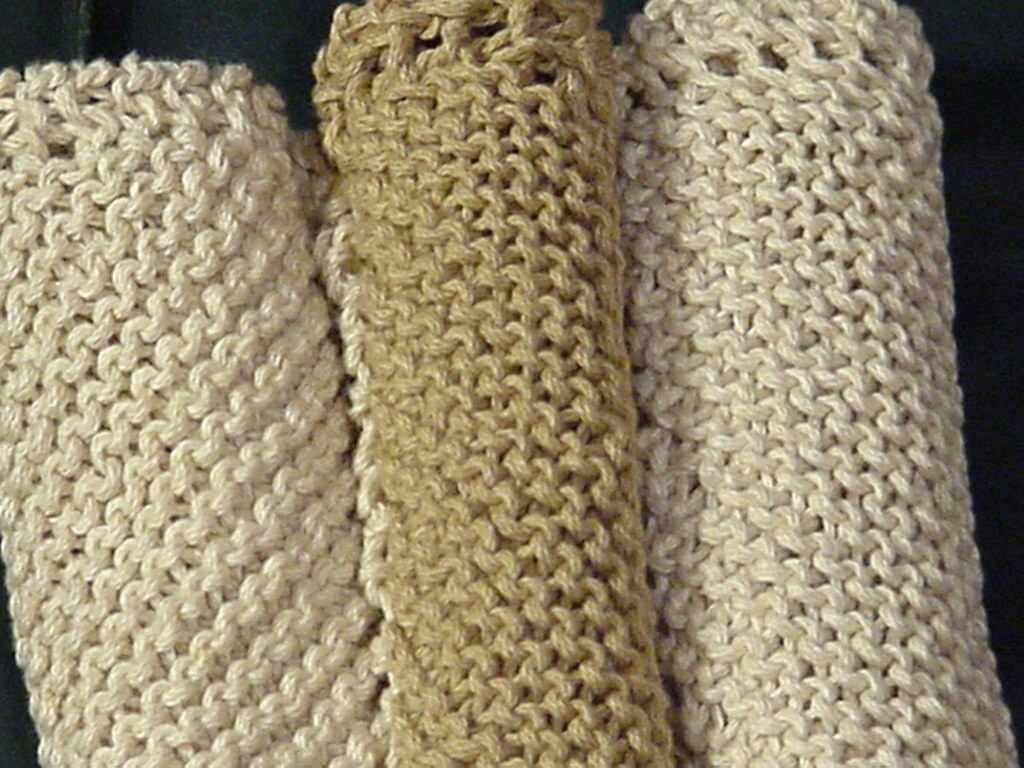
  • A washcloth with a scrubby surface--like this-- (no matter how green some sponges may be, if they are disposable, they are not as green as a good ol' cloth that gets thrown in the wash and reused)
  • A large bucket or bowl and a ladle or cup


THE STEPS (and btw... I will make this seem more complicated that it actually is... I can't help myself! Please keep that in mind):

  • Fill up one sink half full with hot water and a squirt or two of your soap. Don't use a lot of soap; you are not looking for a bubble bath here. You can add a bit more soap later as needed, along with a bit more hot water if the water cools while you work. Now, add dishes, cups, whatever. You know the drill! (To keep water use and nastiness to a minimum, I do not pre-rinse the dishes, nor do I use the disposal. I scrape whatever food is on the dishes --except meat and dairy--into a large empty yogurt container, to be tossed into the compost bin later.)
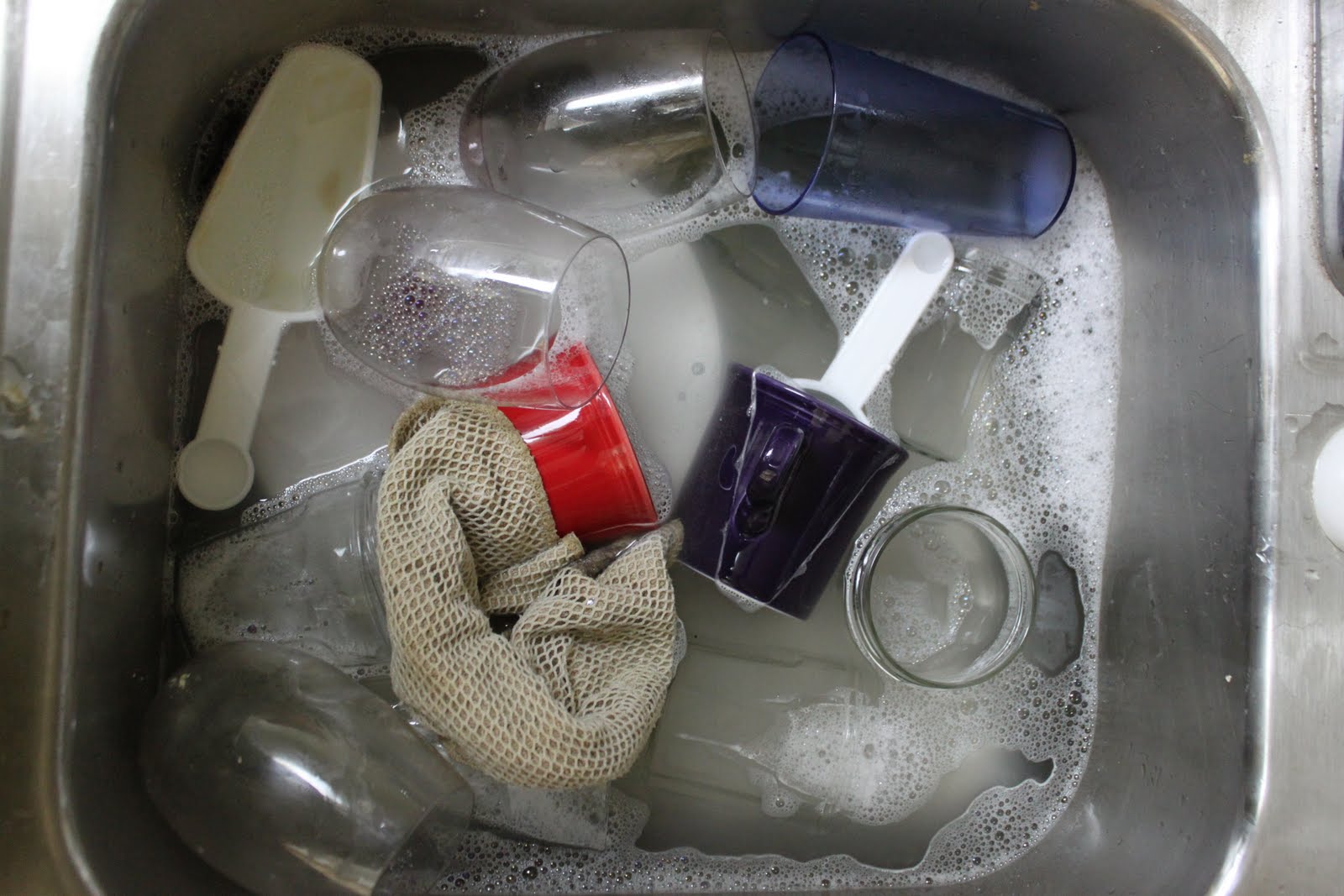
  • While those soak a bit, start filling up the other sink or basin halfway with cold water. This will be your rinse water (pictured below).
  • The next is obvious. Wash, dip in cold rinse water (making sure your dish/glass etc isn't covered in bubbles before you dip) and place in dish drainer.
  • If you finish one sink-full and you have more to wash, simply add another small squirt of soap and turn on the hot water for a couple seconds to warm it up and get a couple bubbles going.
  • Unless you have a gray water recycling unit under your kitchen sink, don't drain the water just yet. :) Now here's the BEST part!


HOW THIS SAVES WATER:


You can water your plants, both indoor and out, with water from your kitchen sink. As a bonus, soapy water with a biodegradable soap can act as an eco-friendly pesticide for your garden. It is recommended that grey water not be used on anything leafy or growing in the ground that will be consumed raw (lettuce, carrots, etc.); however things like fruit trees and ornamental plants are perfectly fine.

I use a cup to fill a large bowl (pictured above) a few times with the water from both sinks and simply head outside to water whatever needs it. You could be slightly more elaborate and have a large covered basin outside to store the water, filling a watering can from the basin when you need it, or go all out and set up a more intricate above or below-ground irrigation system... and many other options in between. I prefer simple (for now!)


You can also flush a toilet with a bucket of water. The average toilet uses 1.5 to 3 gallons per flush. Quickly pour 4 cups of water into the toilet bowl and watch what happens :) If you don't have a garden, or find that you have more grey water than you can use in the garden, keep a bucket of grey water by the toilet.

A word on bacteria. Some people claim the only way to kill bacteria on dishes is with HOT water, such as in a dishwasher. And, others fear the bacteria that may reside on a washcloth. I have three things to say to that:

  1. Our great-grandparents (and many before them) managed somehow to survive this.
  2. They survived it well enough to spawn all of us... nearly 7 billion and counting
  3. Antibiotics, if shit from the washcloth actually hits the fan. (But seriously, lest anyone think I am pushing the use of powerful pharmaceuticals in place of safe hygiene, refer back to points 1 and 2. I think we sometimes fail to give enough credit to the thousands of generations that managed before us without all the trappings of convenience we've convinced ourselves we can't live without.)
Have any dishwashing conservation tips you'd like to share? :)


*(Ecover rebuts greenwashing claims)

Monday, January 24, 2011

Rethinking Beauty: Shampoo and Conditioner

A week ago, I decided to try a new shampoo and conditioner.


Some pics of my do:


Gif Created on Make A Gif


Gif Created on Make A Gif


Keep in mind here, I'm an au naturale kinda girl. I style my hair with my fingers most days... maybe with a comb if I'm feeling really spunky. I prefer my natural waves to anything I could get out of a bottle or from a straightening iron. I only have a blow dryer so my mom doesn't have to bring hers when she visits. So take this hair and envision it as you might cut and/or style it per your habits and preferences.


On GOOD's Facebook page, I had read about the No-Soap Challenge, which could also include no shampoo. I'd been wanting to try this and this was just the oomph I needed!


After a bit of investigating, I found this extremely helpful blog which recommends using a mixture of one tablespoon baking soda mixed with one cup water for shampoo, and one tablespoon apple cider vinegar with one cup water for conditioner. (The blog also gives a few reasons for switching. For a more detailed read about the ingredients commonly found in shampoo and the dangers beauty products pose to health and the environment, go to CopperWiki, a "community based collaboration to build world’s largest repository of information about living consciously.")

I made a few changes to the recipes. For the shampoo, I mixed three drops of rosemary essential oil with the baking soda and water in a bottle. To use, I shook the bottle well, wet my hair, applied a few tablespoons of the mixture to my roots only, and massaged for a couple minutes. Massage gets the blood flowing to the follicles and promotes hair growth. Then I rinsed, which brought the baking soda down through the hair to the ends.

For the conditioner, I mixed two tablespoons of the vinegar with the water, plus 1/4 tsp each raw honey and jojoba oil, plus 3 drops of lavender essential oil (I live in the desert and my hair is prone to dryness; my hair needs lots of lovin'). Shook it up. Squirted a few tablespoons on the ends of my hair (from about ears down). I let it sit a few minutes, and then poured a bit more on the top of my head and rinsed with cool water.

That first day, my hair felt just like it would after a normal shampoo and condition. Two days later, I did it again; this time, the hair was rather oily. Two days later, I washed it (the first set of photos), and again the very next day (the second set of photos).

You'll notice that in the first set of photos, the hair has a slightly oily look to it, perhaps like I hadn't washed it for a couple days. In the next set of photos, my hair still slightly damp, it looks like I'd maybe washed it the day prior (which, by the way, is when I think hair looks its best and is the easiest to manage).

The scalp produces an excess amount of oils to compensate for the harsh detergents in shampoo. This oil builds up near the scalp (as you've likely noticeed if you've ever tried to just rinse your hair with water a day after shampooing it and suddenly found yourself in possession of a greasy, gummy mass of hair); however, since most of us either shampoo every day, or keep the hair dry between washes, we never really notice this excess oil because it stays in place near the roots. We wash, the shampoo strips it away, thus forcing the scalp to produce more, thus necessitating a harsh shampoo, and the cycle continues.


So, for a few days to a few weeks after beginning the gentler baking soda "shampoo" regimen, the scalp will still produce more oil than it needs. It takes time to heal. This transition period doesn't last long. Already, as can be seen in the photos, a week after beginning, things are already starting to balance out.

I'm loving it. My hair feels soft and full. I've lessened the number of chemicals my skin (the largest organ of the body!) comes into contact with. I've lessened the amount of toxic crap that goes down the drain. I can use items I already always have in my pantry, thus saving money and cutting back on plastic waste. And, I get to have fun with different essential oils. I'm totally sold on this and will never shampoo or condition my hair again :)

It's recommended that the wash be done two or three times a week, and the conditioner once or twice a week. If you decide to give this a try, find the combination that works best for you. And remember to be patient while your scalp comes back to a less stressed-out, balanced, healthy state.

Per request... wonder what shampoo these kittehs use?